Sunday, August 9, 2015

Marinated Silken Tofu

It occurs to me that the more veganism is conquering the world, the professional chefs show more and more creativity in their vegan dishes. For the Western the Asian chefs, tofu is one the ingredients that challenges to get more creative:


Marinated Silken Tofu (with thanks to Fan Wei Kong)

1) Ingredients

One box of silken tofu (300 gr)

2) Ingredients marinade

1 tablespoon of light soy sauce
1 tablespoon of dark soy sauce
2 teaspoons of sweet chili sauce
1 teaspoon of sesame oil
Black pepper to taste
1 teaspoon of rice vinegar

3) Ingredients sprinkles

1 tablespoon of roasted peanuts, chopped
Sushi seaweed (laver)
2 spring onions
1 teaspoon of fried onions
1 table spoon of coriander
1 small clove of minced garlic

Method


Put the silken tofu upside down in a small square bowl (just fit).
Prepare the marinade: put all the ingredients together, mix well and pour over the tofu. Let it marinate for a few hours.

Prepare the sprinkles just before serving:
Roast the peanuts and chop.
Roast the seaweed till it gets crunchy and break in pieces
Chop the spring onions
Chop the coriander
Fry the onions or use ready(-to-eat) ones
Mince the garlic

Cover the marinated tofu with the seaweed, mix the other ingredients and sprinkle on top of the tofu!

Ready to eat.


True nobility and wellness for all concerned!


Monday, August 3, 2015

Chaos, order and chickpeas, a quick recipe

Is there order without chaos;
Purity without pollution;
Peace without war;
Love without hate;
Life without death;
Truth without lie;
Future without past;
Compassion without cruelty;
Vegans without carnivores?

Is the unity of contradictions the basis of completeness?  Are contradictions just the different sides of the same coin, called life?
For all those who take the contradictions of life, the contradictions that keep the universe going, as an excuse for the cruelty of exploiting and killing of other sentient beings: please understand that this view is a philosophical exercise. A thought experiment is not to be acted out in real life. Just as we do not start wars to understand peace, or lie as an excuse to understand the nature of truth, just so we do not perform acts of cruelty to become compassionate.

No suffering or contradictions go into one of my favorite recipes for a quick and healthy chickpea meal:

Ingredients

1 big can of chickpeas (800 gr., drained weight 480 gr.)
½ small can tomato squares (400 gr.)
2 tablespoons of sunflower oil
1 onion, cut into small pieces
2 cloves of garlic, grated or finely cut
1 cm. ginger, grated or finely cut
1 teaspoon of cumin
1 teaspoon coriander seed, powdered
¼ teaspoon chili powder
2 teaspoons chana massala*
Salt to taste
2 table spoons coriander leaves

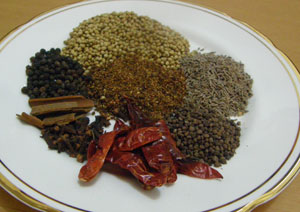
* If you cannot find chana massala: the ingredients of the mixture are listed below

Method

Drain and rinse the chickpeas
Heat the oil
Fry the cumin seeds for one minute
Add the cut onion, fry until golden, add garlic and ginger, stir and mix well, add the spices, mix well.
Add the tomato cubes and salt, bring to boil and let simmer for 5 minutes.
Add the chickpeas, bring to boil, simmer for 10 minutes, add coriander leaves and simmer for another 3 minutes.

Ready to eat!


* The ingredients of the chana massala mixture are


2 tablespoons cumin seeds
1 teaspoon dry pomegranate seeds (anardana)
5-6 red chilies
1 teaspoon turmeric powder
1 tablespoon coriander seeds
½ tablespoon black peppercorns
10 cloves
1 tablespoon sesame seeds
10 green cardamom
4 black cardamom
½ tablespoon ginger powder
1 tablespoon mango powder (amchur)
2 cinnamon sticks
2 bay leaf
1 star anise
½ tablespoon nutmeg
½ tablespoon rock salt (black salt)

Dry roast all the ingredients. Allow to cool, then grind and store it in an air tight container for future use.


Sunday, July 26, 2015

Apricot cake and the uncomfortable relationship between vegetarianism and veganism


Since the dawn of history, some people decided to embrace vegetarianism for various reasons, such as religion, health, ethics or for the environment. Vegetarians have a meat-free and fish-free diet. Different labels apply: lacto-ovo vegetarians include eggs and dairy in their diet; pesco-vegetarians eat fish and are considered pollo-vegetarians; the flexitarian is someone who eats vegetarian sometimes but non-vegetarian at other times. The pesco- or pollo-vegetarian and flexitarian are not considered vegetarians.


The vegan. A vegan will not eat anything to do with animals, which includes meat, fish, dairy, eggs, and honey.  And as erstwhile vegetarians they may have come to embrace veganism for several reasons.  However, being a vegan can be a lifestyle as well. Such vegans also shun clothing, shoes, cosmetics or anything that has to do with (use and exploitation of) animals.  Although it is often hard to make the distinction, there are dietary vegans, who are vegans because of their health, and there are the ethical vegans who have embraced veganism on political or moral grounds. They respect all animals as sentient beings and take a stand against any form of exploitation, suffering and killing of animals.

When talking about the uncomfortable relationship between vegetarians and vegans, it is mostly due to the ethical vegans. A vegetarian may be opposed to the killing of animals but when consuming dairy and eggs not aware that these are products of the exploitation of animals, and even killing of animals, such as the killing of male chicks as an unwanted byproduct of egg production, not being able to lay eggs and not fit for consumption. Hence they claim that vegetarianism and veganism have nothing to do with each other; while ethical vegans simply do not differentiate between meat-eaters and vegetarians as both eat products that come from the exploitation of animals.

However, in their zeal they forget about another aspect: their own road to veganism. The personal history of each and every vegan illustrates how at some point in their life someone started to embrace a vegan lifestyle. Some may have ‘converted’ to veganism overnight, however, the majority of vegans started out as vegetarians, and few, a very few grew up in a vegan household, but that is still a very small minority. Does this imply that one can speak of gradual growth in morality? No, absolutely not, but I presume that gradually (or very fast) more and more people become aware of the suffering and exploitation of animals. Most people have no idea of the cruelty in the food industry, no idea what is really happening with our food before it gets to the store. Most people need the transitional step of vegetarianism, that is, no longer willing to be responsible for the exploitation of animals, and along with that dawns the awareness of suffering of animals as sentient beings.

Therefore vegetarians and vegans can and do break bread together, or for that matter, scrumptious apricot cake!

Apricot cake

Ingredients

  • 350 gr. fresh apricots
  • 175 gr. almonds
  • 100 gr. candied orange peel, cut in pieces, ca. 1 cm.
  • 125 gr. sugar
  • 200 gr. flour
  • 75 gr. sunflower oil
  • 2 tablespoons ground linseed, 6 tablespoons water
  • 1 teaspoon psyllium
  • Pinch of salt
  • 1 ½ teaspoon baking powder
  • ½ teaspoon baking soda

Method

Mix the powdered linseed with water and leave for ten minutes until glutinous 
Grease and line a small loaf tin.
Cook the apricots until soft, remove the pits and mash.
Grind the almonds.
Mix apricots, almonds, sugar and a pinch of salt, mix well to a smooth mixture
Add sunflower oil, glutinous linseed mix well.
Add flour and psyllium, mix well
Add chopped orange peel, baking powder and baking soda, mix and pour immediately into the prepared tin.
Bake for 45 min at 180⁰C


Sunday, July 12, 2015

Bulgur salad with olives and preserved lemons


Superfood is an interesting label. Used by many people as if it were a real food category. Superfood is considered to be nutrient-rich and to be especially beneficial to your health. Examples would be seeds (are we birds?), nuts (are we squirrels? Yes, I am.) and berries in general, and dark green vegetables (which suddenly made kale very fashionable), citrus fruits, many vegetables, legumes (in particular lentils), grains and fatty fish (poor animals, let them keep their fat to themselves, please!).


But let’s be frank, it’s just a marketing tool and lots of people are literally buying it. Although it sounds great, we should be critical as many health benefits ascribed to superfoods are under scrutiny by scientific studies and the jury is still out.
Are so called superfoods healthy? Well, I presume it is certainly not unhealthy and the majority of the people consuming superfoods supposedly have a healthy diet. Consumption of superfoods is more an indication that one belongs to a subgroup of consumers who observe a healthy, modern lifestyle and for some reason fall for the perhaps (super) myth projected on this category of food.

Real superfood is clean, fair, and local, food that in the production and sales process is free of exploitation. To me that is really super!

Let’s enjoy this thought with a super summery salad.

Bulgur salad with olives and preserved lemons


Ingredients 

1 cup Bulgur (200 gr)
2 tablespoons olive oil
2 cups vegetable stock (400 ml)
¼ teaspoon salt
1 can (14 ounce) can chickpeas, drained and rinsed (400gr)
1 cup fresh coriander, chopped
3 tablespoons fresh mint, chopped
2 scallions, green and white parts, thinly sliced
1 cup large green olives or Kalamata olives, pitted, roughly chopped
¼ finely chopped dried apricots
½ pound zucchini, diced
1 tablespoons chopped roasted pistachios
2 tablespoons minced preserved lemons

Lemon dressing

2 tablespoons olive oil
2 tablespoons minced shallots
1 teaspoon ground coriander
½ teaspoon turmeric
½ teaspoon cinnamon
½ teaspoon ground cumin
¼ teaspoon cayenne pepper
¼ cup freshly squeezed lemon juice
1 tablespoon agave nectar or pure maple syrup
½ teaspoon salt

Method

In a large saucepan, heat 2 table spoons of olive oil, toast the bulgur over medium heat, stirring constantly, until just slightly toasted, about 5 minutes.  

Add the vegetable stock, bring to a boil, and turn down the heat. Cover and simmer for 20 minutes, until the liquid is absorbed. Remove from the heat, remove the lid, and cool while you prepare the other ingredients.


Place the chickpeas, coriander, mint, scallions, olives, apricots, zucchini, pistachios, and preserved lemon in a large mixing bowl.

Prepare the dressing: heat the olive oil in a small saucepan over medium heat, add the shallots, and sauté for 2 minutes, or until softened and golden. Stir in the corianders, turmeric, cinnamon, cumin, and cayenne and fry for 30 seconds, then remove from the burner. Cool for 1 minute, then stir in the lemon juice, agave, and salt and whisk until smooth. Add the couscous to the chickpea mixture and pour the dressing over it. Stir very well to coat everything with dressing. Cover and chill salad before serving.

By the way, the salad looks super colorful and festive! Problem is for that reason it was finished before I was able to take a picture.

Afbeeldingsresultaat voor bulgur salad zucchini chick peas
... but this is what it looks like ...

Saturday, July 4, 2015

Clean food, clean conscience

What is the idea behind clean food and clean eating? Washed hygienically? Alright then,  let’s not be silly. Is it the latest hype in culinary land? Let’s hope it is not a hype but a movement back to fresh, non-processed food, GMO-free, etc.

For most people, clean food and clean eating implies GMO-free food, organically grown, etc. , and for others, it is about healthy food. Clean eating stresses healthy, whole, unprocessed foods.


But is that really clean? For me, clean food is food for a clean conscience. Clean food implies that no sentient being has been exploited and/or killed, or had to suffer for the food. But also that the earth was not exploited, being left polluted or exhausted because of all kinds of agricultural poisons and monoculture. No human being has been exploited in the process from growing to selling to preparing. No animal is involved in the clean food chain. And growing awareness that food should not be wasted, don’t buy and cook more than you can eat as too many people overeat or else waste food while others starve. Be grateful and share. Cultivate a clean conscience.
Is this a vegan dream? No, lots of people are already nourishing themselves like this and adapting it has become a complete lifestyle, a philosophy of life in which life is perceived as a phenomenon to be treasured, revered and respected.

Let’s celebrate life with a mushroom stir.

Mushroom stir

Ingredients


2 tablespoons of olive oil
1 teaspoon of cumin seed
½ teaspoon of mustard seed
1 small red onion
3 cloves of garlic
½ fresh red pepper (or to taste)
250 gr. Chestnut mushrooms
250 gr. Oyster mushrooms
100 gr. Shitake
250 gr. green asparagus or green beans (use what is in season)
Black pepper to taste
Salt to taste?
2 tablespoons of freshly chopped coriander
½ teaspoon fresh lime juice, or to taste

Method

Boil 1.5 liters of water. Blanch the green asparagus or green beans. Cool them briefly after blanching in cold water and cut the asparagus or beans in pieces of about 5cm.
Heat the oil on medium heat for about 1 minute and add in the mustard seeds and the cumin seeds and wait until these begin to crackle.
Add in the red onions and sauté for 3 to 4 minutes until the onions begin to turn slightly crisp at the edges.
Stir in the mushrooms and cook for another 4 minutes, adding in garlic, salt, and black pepper and stir.
Add coriander leaves and asparagus or beans and mix well.
Squeeze in the lime juice to taste and serve.
Eat hearty!

Then do the dirty dishes with a clean conscience :-)


Sunday, June 21, 2015

Vegan time to celebrate


Vegetarianism is perhaps as old as mankind, veganism probably as well or perhaps even older. Both the religious and non-religious.

For those who follow the evolution theory: pre-historic man, who may have been a hunter (and gatherer of roots, fruits and nuts) didn’t cage, enslave, exploit, or mistreat the animals that he ate. And pre-historic man did not abandon eating fruits, nuts and herbs. Gathering fruits, nuts and herbs was presumably a woman’s task, who would likely have developed higher intelligence on the nutritious and healing capacities of plants. All needed in times when game was scarce. For those who subscribe to the theory of evolution, going vegan seems to be the next evolutionary step for humankind as it addresses the problems of global warming, environmental devastation, food scarcity and in particular the ethical call for ending exploitation and suffering.

For those who follow religion in their defense of a carnivorous diet: Judaism, Christianity and Islam do not teach to exploit, mistreat or enslave animals. Their scriptures and traditions highlight not only the rights of animals to have a peaceful life, but in particular that in paradise (or in heavenly spheres) there is only peace and no killing.

Religions such as Hinduism, Buddhism and Jainism have such a clear and strong tradition in non-violence that, for now, I will not pursue that discussion (but will certainly get back to that).

The history of mankind and abstaining of meat-eating is an ancient one that goes back to at least Pythagoras (6th century BC), thus showing that ethical veganism has a long history in Western civilization stretching back to antiquity. Following the long line from antiquity to the present, it becomes easier to understand the decision to the New Zealand government to recognize all animals as sentient beings, see https://www.independent.co.uk/news/world/australasia/animals-are-now-legally-recognised-as-sentient-beings-in-new-zealand-10256006.html

And this is reason for celebration. To most vegans the protection of animals and the recognition of animals as sentient beings, the process may seem too slow in the western world. However, considering that in the 1840’s the term vegetarianism was coined and the first vegetarian society was formed in 1847 in Britain, it took only 170 years until the first recognition of all animals as sentient beings, while it had taken over 2500 years from the days of Greek antiquity to form the first vegetarian society in the Western world. 

Ethical veganism is clearly gaining momentum, a reason to celebrate!

Banana cake

Ingredients

300 gr. ripe or overripe bananas
160 gr. flour
1 teaspoon baking powder
½ teaspoon baking soda
Pinch of salt
75 gr. sugar
75 gr. sunflower oil
1 teaspoon vanilla extract
3 teaspoons cinnamon
75 gr. chopped walnuts or pecan nuts
(to make it more festive:  100 gr. candied orange peel!)
Preheat over 180C
Bake for 40 min at 180C

Method 

Grease and line a small loaf tin.
Mash bananas, add cinnamon, vanilla, sugar, pinch of salt, mix well to a smooth mixture
Add sunflower oil, mix well.
Add flour, mix well
Add chopped walnuts (and orange peel), baking powder and baking soda, mix and pour immediately into the prepared tin.

Bake for 45 min at 180C


The proof of the banana cake is in the eating…


Monday, June 8, 2015

Hunters and gatherers.


Every Saturday, early morning I go out to the main and biggest open market in the Netherlands, the ‘Big Market’ in The Hague, a good place to gather fresh fruits, vegetables, spices, and herbs. One has to be early to hunt for the best deals. A good vegan may think to only gather food, but no, you hunt as well!
For those who labor under the illusion that we have evolved from our days as hunter-gatherers, they should have a closer look at shopping behavior.
Supermarkets and big department stores may have played a significant role in human evolution when it comes to abandoning hunter-gatherer behavior.  However, mankind has not evolved that much. Nothing easier to trigger this instinct with just one word … SALE! And see the herds hunting for the best deals, gathering their treasures in baskets or shopping carts. A stampede of wildebeest seems safer to run into. Don’t think that this behavior only applies to shoe sales!
For the evolved ones: forget about all those specialized delis, stop hunting for the very best quality, just head for a good (biological)  supermarket or local market with your shopping list and you’re done for the whole week! More time to cook, walk, read, dance, love, run, have fun, work, spend time with friends and family!
Or be elitist, if you prefer, and go from deli to deli so as to later on brag about your very unique finds, such as that sweet old-fashioned tea shop where you can get the most amazing green tea, or that Italian deli as the sole place in your town to buy decent pasta, and of course do not forget about that small alleyway where you found the one-and-only place in town to buy organically grown lentils. An absolute must! If this is your hobby, please do continue enjoying it! And ignore me.

The gatherer’s salad from the (super)market

Ingredients:

1 large salad bowl
1 bag of mixed salad with rocket
250 gr. green asparagus
½ cucumber
Handful of baby Roma tomatoes
½ yellow paprika
1 small avocado
A few sundried tomatoes
A handful of black olives (pitted)
Black pepper to taste
Salt to taste
Extra virgin olive oil to taste
Balsamic vinegar
1 tablespoon pumpkin seeds
1 teaspoon pine nuts

Method:

Cook the asparagus for four minutes, drain and cool
Slice the cucumber in big matchsticks
Slice the paprika in big matchsticks
Slice the sundried tomatoes
Cut the avocado in slices

 Toast the seeds and nuts in a dry frying pan over medium-high heat for 2 or 3 minutes.
Take a big salad bowl, toss the salad in it, divide first the paprika and cucumber, the tomatoes, sundried tomatoes, olives and avocado. Arrange the asparagus on top.
Season to taste and sprinkle with olive oil and balsamic vinegar.
Sprinkle the toasted seeds and nuts over the salad.

No need to fish for compliments, just gather them in.

              Enjoy!


Monday, June 1, 2015

Compassion and coconut

Sometimes I have strange ideas about veganism. To think that it is all about respect, compassion, non-violence and non-exploitation of any sentient being. Thinking that those who follow the abolitionist approach in veganism are all compassionate beings, whose compassion reaches out to all sentient beings, even beyond with  genuine compassion for the entire planet. I can relate to that.
However, in their enthusiasm for animal rights, some vegans go overboard and display nasty forms of moral superiority towards non-vegans. In those cases I wonder about compassion, I wonder about the respect for all sentient beings, which I presume include human beings (vegan and non-vegan). Sometimes I try to follow discussions on the internet and read questions of vegans who wonder how to interact with non-vegans; some go that far as to advise shunning non-vegans and the tone of voice is not very respectful. Really? Dissing a sentient being?

Afbeeldingsresultaat voor coconutA recipe for coconut cookies seems to be in order because of the symbolic meaning of the coconut.  


Most people will be acquainted with the ritual of the breaking of the coconut. A ritual with its origin in Hindu practice. Whenever a great work is undertaken or on the reward of an achievement is on its way, it is very human to feel a sense of pride. The ritual of smashing the coconut indicates that the actual ‘actor’ is God and that humans are merely instruments in its hands.

Smashing the coconut is symbolic of annihilating the ego and humbling oneself before God.  The coconut also symbolizes selfless service.
Of course, there is much more to say about the symbolic meaning of the coconut, and in endless praise for it as easily digestible, nutritious, blood enhancer, purifier, etc. But for the sake of abandoning any sort of feelings of moral superiority and for the sake of fostering compassion and respect for all sentient beings, I would like to sweeten things up with this recipe for: Coconut sugar cakes (Kronto koekoe from Suriname, South America)

Ingredients:

1 coconut
Sugar (2 parts coconut, one part sugar)
½ cup coconut water
1,5 teaspoons of fresh finely grated ginger
1 Teaspoon almond essence
Optional: 4-6 drops of red or green food coloring
Baking tray and waxed paper

Method

Line a  baking  tray with waxed paper.

Open the coconut, peel and chop to pieces, and use the food processor to chop into smaller pieces, no grating needed.

Cook the coconut water with sugar and ginger, bring to a rolling boil, add the pieces of coconut and essence, and cook for about 15 minutes, constantly stir until the liquid reduces and gets thick.


Drop the coconut mixture by tablespoon onto prepared baking tray; let cookies cool and harden. Store in airtight container.

                                                 Enjoy!